
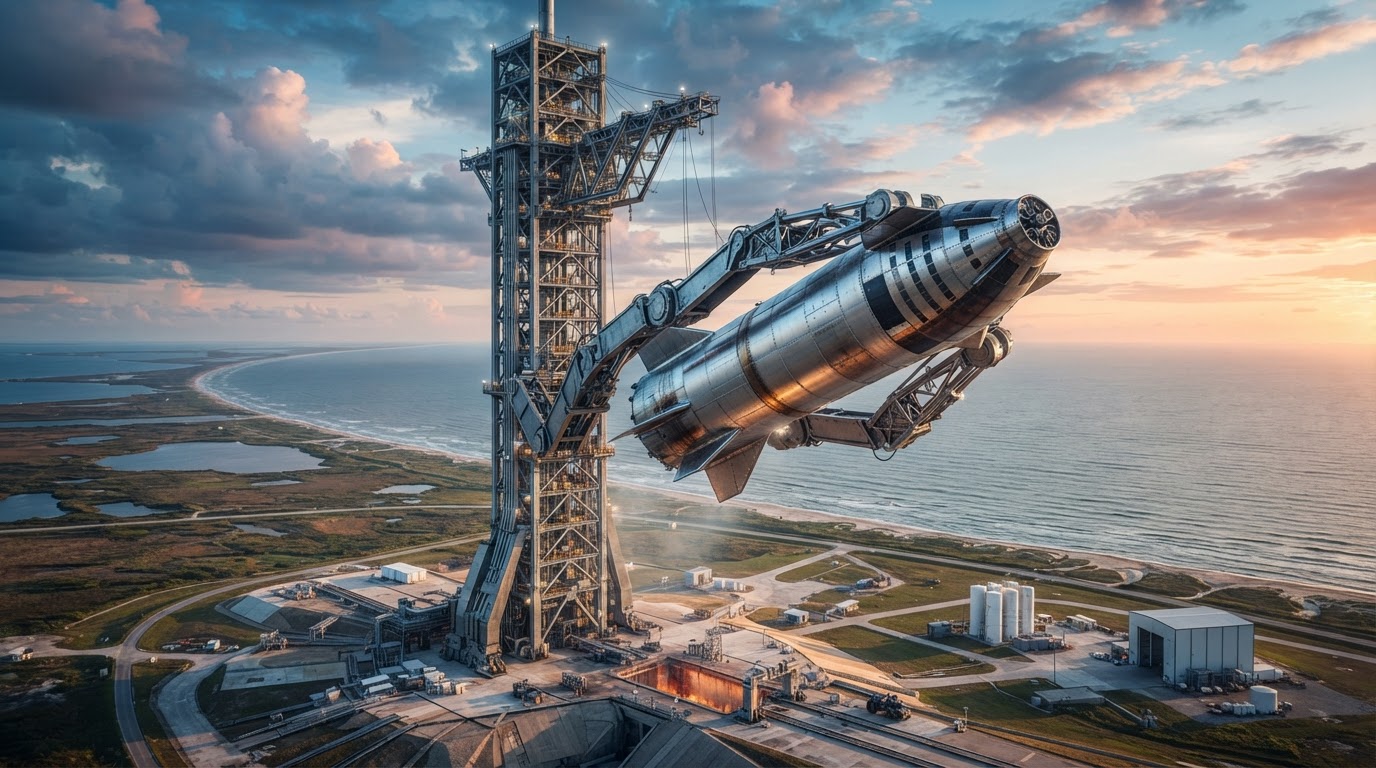
SpaceX has caught the upper stage of its Starship rocket with the mechanical arms of its Texas launch tower for the first time, marking a major step in the company’s effort to make the vehicle rapidly reusable.
The 171-foot (52-metre) spacecraft returned to the launch site after a mission lasting about 22 hours and orbiting Earth 14 times, according to The Guardian. The manoeuvre used the tower’s large mechanical arms, nicknamed Mechazilla, to capture the vehicle rather than sending it to a landing zone or recovering it from the ocean.
The achievement came during Starship’s 15th test flight. It was not a complete recovery of the launch system: the lower Super Heavy booster aborted its planned catch and exploded over the Gulf of Mexico. SpaceX said its guidance, navigation and control system had triggered a no-go because the booster was not in the correct position for a catch. Elon Musk also said the booster was slightly low on fuel.
Why the catch is important
The upper-stage capture is the first time SpaceX has completed the manoeuvre on Starship itself. The company had previously caught Super Heavy boosters, but recovering the spacecraft as well is central to its goal of turning the entire launch vehicle around quickly for repeated flights.
Rapid reuse could eventually lower launch costs and increase the number of missions a single vehicle can perform. That matters to commercial satellite deployment and to NASA’s lunar ambitions: SpaceX has a contract connected to the agency’s Artemis programme, which aims to return astronauts to the Moon. The test does not, however, establish that Starship is ready for operational or crewed service.
A milestone, not a finished system
The test shows progress in precision landing and tower-capture technology, but the booster failure underlines the remaining engineering work. SpaceX still needs to understand the abort, demonstrate reliable recovery of both stages and complete further testing before the system can be treated as a routine launch platform.
The company has also used recent flights to deploy Starlink V3 satellites. Its longer-term plans include a much higher launch cadence, but those ambitions depend on the reliability of the vehicle, regulatory approvals and the results of future test flights.
Sources: The Guardian · The Verge