
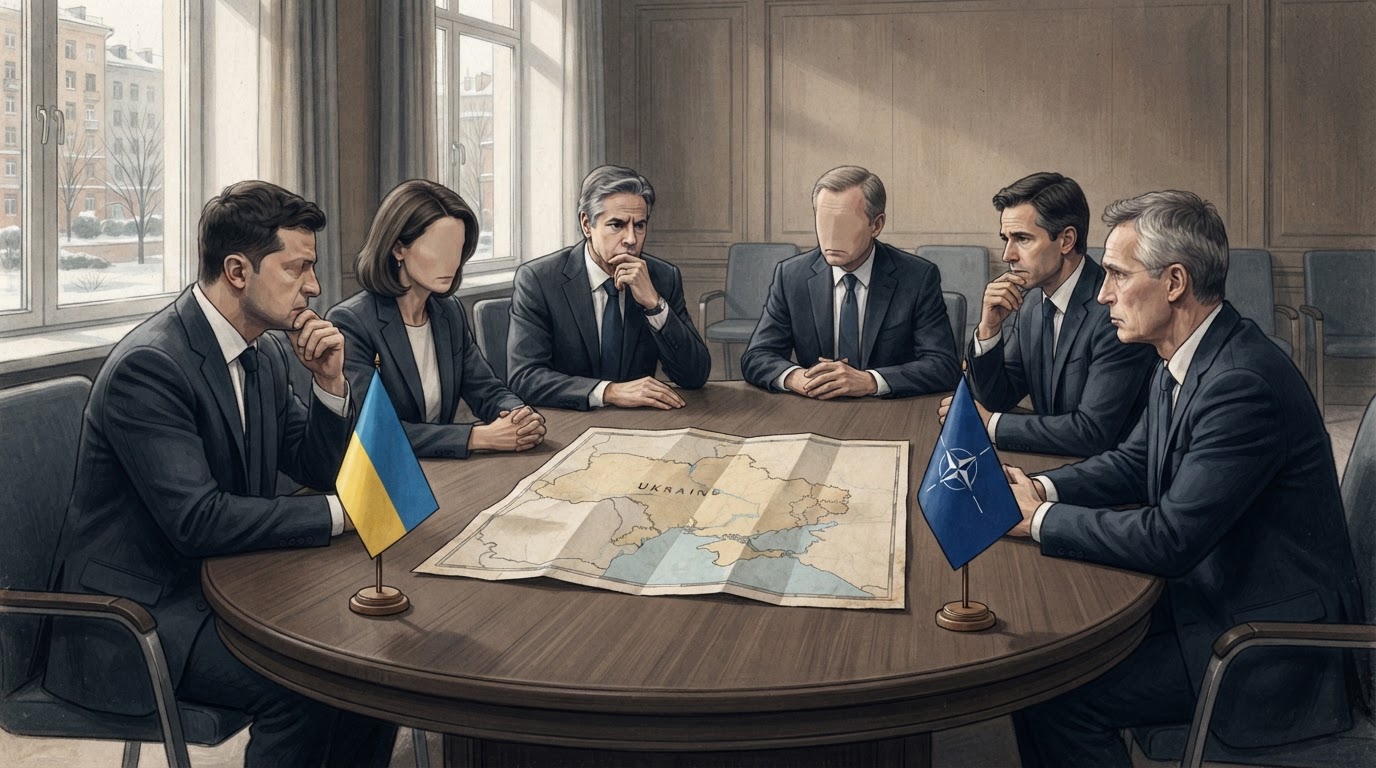
KYIV — Ukrainian President Volodymyr Zelenskyy says US negotiators raised the possibility of Ukraine withdrawing from parts of Donbas in exchange for NATO membership, exposing a new fault line in efforts to negotiate an end to Russia’s war.
Zelenskyy said the question was raised during recent US-brokered discussions with Russia in Abu Dhabi. According to his account, American negotiators asked whether Ukraine might join NATO if it withdrew from Donbas. Reuters reported that Zelenskyy described this as the first time the link between NATO membership and territorial concessions had been raised in the talks.
The reported exchange has not been published as a formal US proposal or agreed negotiating text. It remains Zelenskyy’s account of what was discussed, and should not be read as an accepted settlement framework.
Kyiv rejects territorial concessions
Zelenskyy reiterated that Ukraine would not voluntarily surrender territory. He said he could put a comprehensive agreement to a national referendum if it included credible security guarantees, the right to maintain a strong and adequately funded Ukrainian military, and resources for reconstruction.
He also rejected the idea of negotiating a broad new European security architecture before settling the terms for ending the war. His position is that the fighting must end first, with Ukraine’s future security addressed as part of a durable settlement rather than used as a preliminary condition.
The prisoner exchange is a limited point of progress
The Abu Dhabi talks ended without a major breakthrough, but Zelenskyy said the sides had agreed in principle to a prisoner exchange involving more than 1,000 people. The final numbers were still being discussed. US envoy Jared Kushner said both sides had presented maximalist positions but understood that practical compromises would be necessary.
European officials have also sought a place in future negotiations. After discussions in Dublin, European leaders agreed that Britain, France, Germany, Italy, Poland and EU officials should coordinate Europe’s contribution. European delegates met US and Ukrainian representatives in Abu Dhabi but did not join the talks with Russia.
Why the proposal matters internationally
The question reaches beyond the Donbas front line. It touches NATO’s future relationship with Ukraine, the credibility of security guarantees, the principle that borders should not be changed by force, and the balance of power across Europe. Any settlement that leaves those questions unresolved could shape European defence spending and relations between Russia, the United States and NATO for years.
For now, there is no confirmed agreement on territory or membership. The central issue remains whether negotiators can produce a framework that Ukraine accepts and that offers enforceable protection against renewed aggression.
Sources: Reuters reporting · Associated Press · Financial Times