
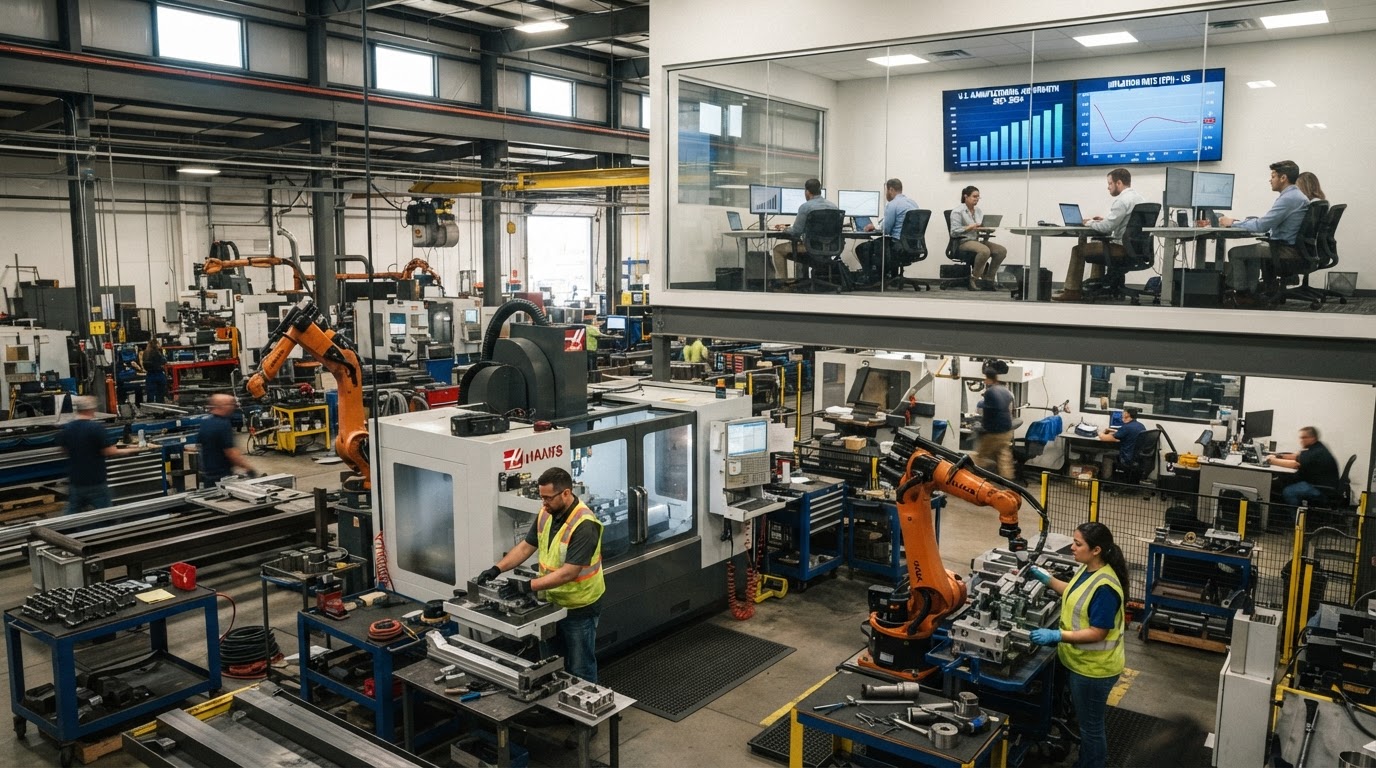
The United States economy is continuing to expand, supported by consumer spending and heavy business investment, but renewed inflation pressure is complicating the outlook for households, financial markets and the Federal Reserve.
Recent data present a mixed picture: economic output grew at a 3.4% annualised rate in the third quarter of 2026, employers added 165,000 jobs in October and unemployment stood at 4.1%. At the same time, consumer prices rose faster than expected in October, raising questions about how long interest rates may need to remain restrictive.
Growth remains firm, led by consumers and investment
The Commerce Department’s advance estimate, reported by Reuters, put third-quarter real GDP growth at a 3.4% annualised rate, the fastest pace in a year. Consumer spending and business investment—particularly spending connected with artificial intelligence, equipment and intellectual property—were major contributors.
The strength of output is important for the global economy because the United States is a major source of demand, investment and financial-market activity. However, strong demand can also make it harder for inflation to return to the Federal Reserve’s 2% objective if supply and production costs remain elevated.
Inflation is again the central concern
U.S. consumer prices increased 0.4% in October, according to figures reported by Reuters on 10 November. The increase was above the 0.3% economists had expected and marked a third consecutive month of relatively strong monthly inflation. Food, shelter, transport and household costs contributed to the rise.
Higher energy costs, import tariffs and resilient consumer demand have added to the challenge. The latest figures suggest that price pressures are not yet securely under control, even as policymakers continue to assess the effects of earlier monetary tightening.
The labour market remains resilient
The U.S. Bureau of Labor Statistics reported that nonfarm payroll employment increased by 165,000 in October and the unemployment rate was 4.1%. Hiring gains were recorded in professional and business services, health care, and transportation and warehousing.
A relatively stable labour market supports household income and consumer spending. But continued employment strength, alongside elevated inflation, may leave the Federal Reserve with less room to ease monetary policy quickly.
What the Federal Reserve is watching
The Federal Reserve’s policy rate target range was 3.75% to 4.00% in its October 2026 decision. Fed officials have stressed that inflation remains elevated and that future decisions will depend on incoming evidence about prices, employment, energy markets and financial conditions.
For investors, businesses and borrowers, the path of interest rates matters well beyond the United States. U.S. Treasury yields influence global borrowing costs, while Federal Reserve decisions can affect the dollar, international capital flows, equity valuations and the cost of financing for governments and companies worldwide.
Why the U.S. outlook matters globally
Developments in the American economy can influence demand for imported goods, commodity prices, global technology investment and financial-market sentiment. A stronger-than-expected U.S. economy may support international trade, while persistent inflation and higher interest rates can tighten financial conditions for businesses and borrowers around the world.
The next indicators to watch include retail sales, further inflation releases, labour-market data and the Federal Reserve’s communications ahead of its December policy meeting. Together, they should provide a clearer picture of whether the economy is cooling enough to ease price pressures—or whether interest rates may need to stay higher for longer.
The Fexora perspective
The central tension in the U.S. economy is increasingly clear: growth and hiring remain robust, but inflation is proving difficult to contain. The balance between those forces will shape the Federal Reserve’s next decisions and could influence markets well beyond America.
Published 15 November 2026. This report reflects economic releases and reporting available by that date. GDP growth is stated at an annualised quarterly rate; employment and inflation figures retain their original reporting periods.
Sources
- Reuters: U.S. consumer prices rise briskly for third straight month (10 November 2026)
- U.S. Bureau of Labor Statistics: The Employment Situation — October 2026 (6 November 2026)
- Reuters: Robust consumer spending and AI-related investment power U.S. economy in Q3 (29 October 2026)
- Federal Reserve: The U.S. Economy and Considerations for Monetary Policy (10 November 2026)